
Ever flip through an old family Bible and spot a name so pretty you wonder why nobody uses it anymore? That’s the pull of Victorian names. They carry a quiet charm that feels fancy and warm at the same time, like something borrowed from a favorite old novel.
Whether you’re naming a baby, a pet, or a character in a story, this list of 1800s names has something for you. You’ll walk away with over 110 real Victorian names, plus tips for picking and personalizing the right one. Grab a cup of tea and let’s dig in.
What Are Victorian Era Names?
The Victorian era ran from 1837 to 1901, back when Queen Victoria sat on the throne of England. Naming a baby back then was a bigger deal than picking something that just sounded nice. Families often leaned on the Bible, on royal favorites, or on names passed down from grandparents. A name told people who your family was, what your parents believed in, and sometimes even how much money you had.
That’s why Victorian era names feel so rich today. They weren’t picked at random. Each one carried weight. Many were short forms of Latin or Greek words tied to virtues like purity, strength, or grace. Others honored the royal family directly, since Queen Victoria and Prince Albert were basically the celebrities of their day.
Here’s a peek at some of the most iconic names from the era, the ones you’ll spot again and again in old church records and family trees:
• Albert
• Victoria
• Edward
• Alexandra
• Arthur
• Leopold
• Beatrice
• Helena
• Alfred
• Frederick
• Augusta
• Adelaide
• Louise
These names show up so often because royal babies got named first, and everyone else copied the pattern. When Queen Victoria named her own children, half of England seemed to follow her lead within a year. If you want a name that feels regal without trying too hard, this list is a great place to start.
There’s also a practical side to why these names spread so fast. Church registers from the time show whole villages full of the same handful of names, passed from grandparent to grandchild like a family heirloom. A boy named after his father’s father was seen as a small tribute, a way of keeping the family line alive on paper as much as in person. Girls often carried a mother’s or aunt’s name too, sometimes tucked in as a middle name so nobody got left out.
Picture a Victorian mother sitting by candlelight, running her finger down a family Bible looking for the right name. She wasn’t just picking sounds she liked. She was choosing a name meant to carry a bit of family history, a bit of hope, and sometimes a quiet nod to whichever relative she wanted to please the most.
It also helps to remember that spelling wasn’t always locked in stone back then. Many names had two or three common spellings floating around at once, and a family might spell a name one way in the church register and another way on a tombstone. That flexibility is part of what makes Victorian names so fun to play with today.
ALSO READ MORE:https://thetophexas.com/anglo-saxon-names/
Most Popular Victorian Names in the 1800s for Boys and Girls
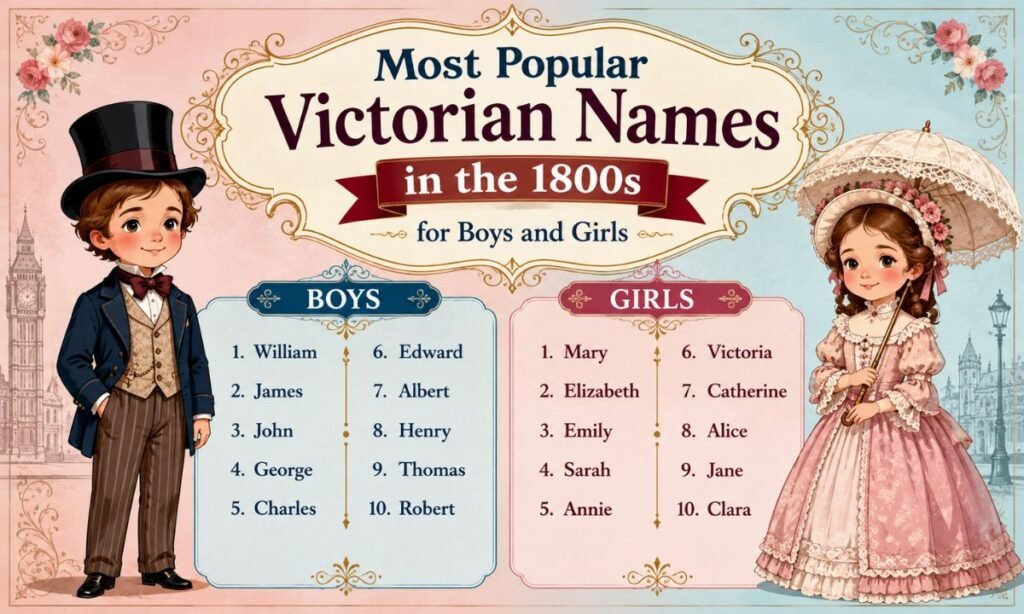
Picture a Victorian schoolroom. Half the boys would answer to William, and half the girls would answer to Mary. Some names were so common that families used nicknames just to keep everyone straight at the dinner table.
Here are the boy names that topped the charts:
• William
• John
• George
• Thomas
• Charles
• Henry
• James
• Robert
• Samuel
• Joseph
• Benjamin
• Daniel
• David
And here are the girl names every household seemed to have at least one of:
• Mary
• Elizabeth
• Sarah
• Emma
• Alice
• Florence
• Edith
• Ada
• Jane
• Anne
• Margaret
• Susan
• Ellen
Notice how plain and sturdy these feel? That’s the point. Parents wanted names that would age well, since a baby named Charles was expected to still be Charles at eighty. Simple, solid, and never out of place, that’s what made these names last through the whole century.
A big reason for the overlap comes down to church tradition. Most Victorian babies were baptized within days of being born, and vicars often steered families toward names straight from scripture. That’s part of why John, James, and Mary pop up over and over in old parish records. Families weren’t trying to be original. They wanted a name that felt safe, proper, and blessed.
If you’re naming a baby today and want that same sturdy feeling, these names still work beautifully. They pair well with almost any surname, they never sound trendy or dated, and they carry a quiet dignity that has held up for close to two hundred years.
Victorian Girl Names from the 1800s
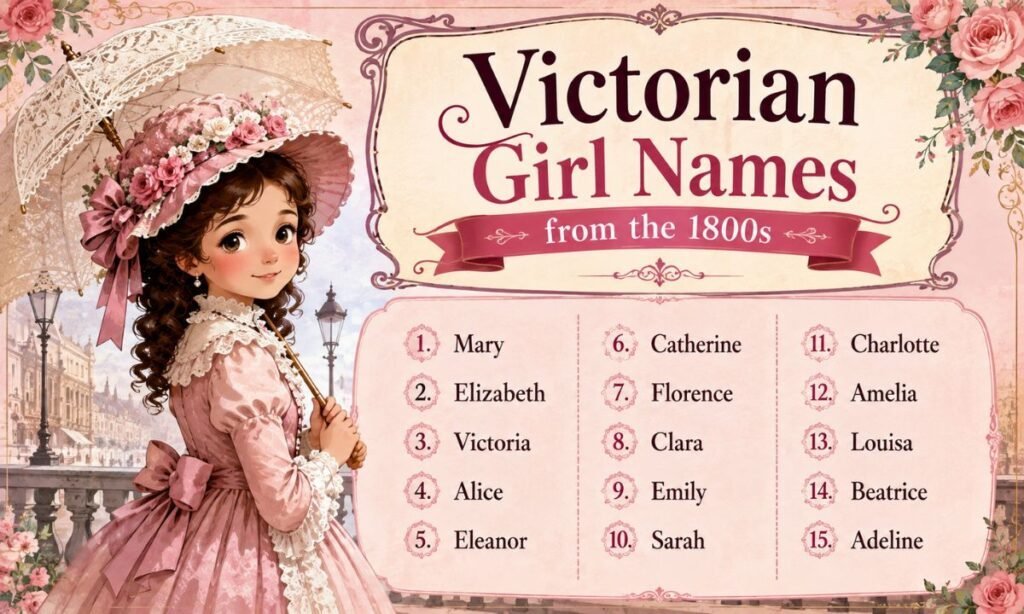
Beyond the obvious favorites, plenty of Victorian girl names had a softer, more old-world feel. These are the ones that sound like they belong in a novel by the Brontë sisters, the kind of name a governess or a farmer’s daughter might have carried.
• Agnes
• Constance
• Mabel
• Winifred
• Gertrude
• Hilda
• Maude
• Ethel
• Bertha
• Millicent
• Rosalind
• Cecilia
• Prudence
A lot of these have a lovely nickname hiding inside them too. Winifred can turn into Winnie, Millicent into Millie, and Gertrude into Gertie. If you like a name with a built-in cute short form, these are worth a second look.
Names like Agnes and Hilda were often given to the eldest daughter in a household, since older names carried a sense of steadiness that parents wanted for the child expected to help raise her siblings. Younger daughters sometimes got the softer, newer sounding names of the bunch, like Mabel or Cecilia, which felt a touch more playful for the era.
What’s fun about this list is how many of these names are quietly climbing baby name charts again. Parents who want something their child won’t share with five other kids in class are rediscovering names like Winifred and Prudence, and honestly, they deserve the second chance.
Victorian Boy Names from the 1800s
Boy names from this era often carried a bit of formality, the kind of name you’d shout across a courtyard and expect a proper response to. They sound sharp, a little stiff, and honestly kind of cool today because nobody else is using them.
• Cecil
• Reginald
• Percival
• Sidney
• Walter
• Herbert
• Cuthbert
• Ambrose
• Bertram
• Clarence
• Ernest
• Horace
• Wilfred
Reginald and Percival almost sound like they belong to a knight in a storybook, and honestly, that’s not far off. Names like these were common among families who wanted their sons to sound a little noble, even if the family itself was just ordinary folk working a trade.
A lot of these names trace back to Old English or Old German roots and originally meant something bold, like strong counsel or bright warrior. Parents who chose Wilfred or Ernest for their sons were often hoping the meaning behind the name would rub off a little, giving the boy a head start on the kind of man he’d grow into.
These days, names like Cecil and Clarence feel almost like secret weapons for parents tired of the same five boy names showing up on every school roster. They’re easy to say, easy to spell, and carry a whole lot more personality than most names on the list of current top picks.
Common Victorian Names in the 1800s
Not every Victorian name was fancy. Plenty of everyday families picked names that were plain, practical, and easy to spell. These were the names of shopkeepers, farmhands, and the woman who ran the corner bakery.
• Martha
• Fanny
• Harriet
• Dorothy
• Nancy
• Priscilla
• Rebecca
• Peter
• Edmund
• Isaac
• Nathan
• Simon
• Matthew
There’s something comforting about these names. They don’t try too hard, and that’s exactly why they still show up on birth certificates today. If you want something that feels timeless without feeling stuffy, this list is your sweet spot.
Think about the average Victorian household for a second. Big families were the norm, often with six, seven, or even ten children under one roof. With that many kids to keep track of, parents leaned on names that were quick to say and hard to mix up. Martha and Nancy roll off the tongue easily, and Peter and Matthew are just as simple.
Names like these were also less about status and more about belonging. A family working the fields or running a small shop didn’t need a name dripping in royal flair. They needed a name their neighbors would recognize, their pastor would approve of, and their child could carry through a hard, honest life without ever feeling out of place.
Elegant and Classic Victorian Names
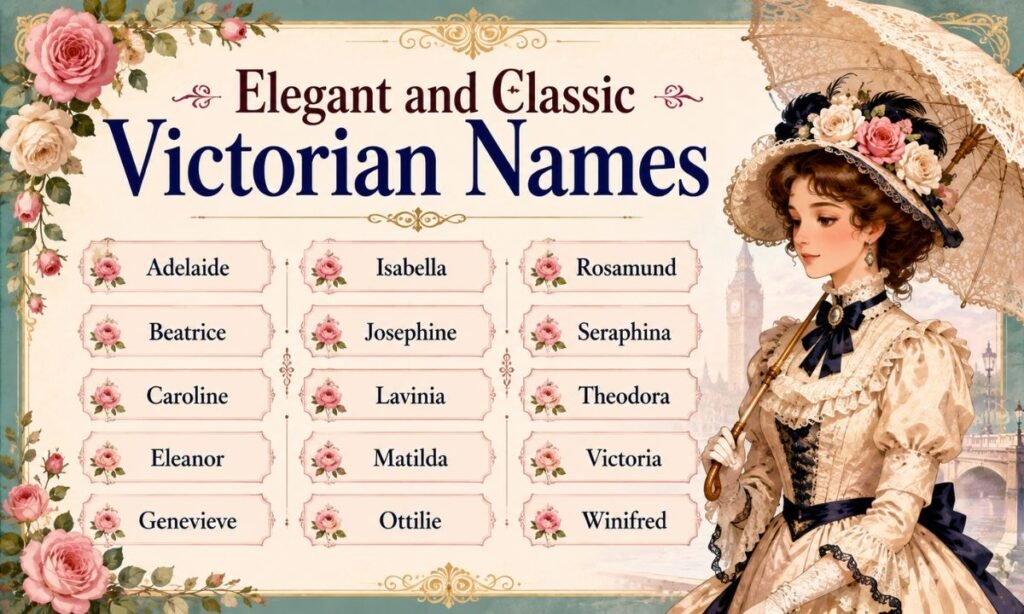
Some names were built for the drawing room instead of the farmhouse. These carry a bit of drama, a bit of sparkle, the kind of name you’d expect on an invitation to a fancy ball.
• Isabella
• Genevieve
• Rosamund
• Theodora
• Evangeline
• Seraphina
• Vivienne
• Sebastian
• Julian
• Theodore
• Maximilian
• Nathaniel
• Alistair
Names like Seraphina and Evangeline practically sing when you say them out loud. Wealthy families in the Victorian period often reached for names with a French or Latin flair, since it signaled education and good taste. If you want a name that feels like silk gloves and a good pocket watch, look no further.
A lot of these names have deep roots in poetry and literature too. Victorian novelists loved giving their heroines names like Rosamund or Theodora, partly because readers already associated those names with grace and a hint of mystery. Naming a real baby Vivienne or Sebastian still borrows a little of that same storybook shine today.
If you’re drawn to this list, chances are you like a name with a bit of presence. These names hold their own on a wedding invitation, a diploma, or a boardroom nameplate just as easily as they would have on an 1870s calling card.
Rare and Unique Victorian Names
Now for the fun part. Some Victorian parents got downright creative, especially the Puritan-leaning families who liked to name their kids after virtues. You won’t meet a lot of people with these names today, which makes them stand out even more.
• Araminta
• Verity
• Temperance
• Honor
• Patience
• Zilpha
• Euphemia
• Barnaby
• Silas
• Ezekiel
• Obadiah
• Thaddeus
• Peregrine
Verity and Honor are having a bit of a comeback lately, and it’s easy to see why. They sound fresh and old at the same time, almost like they never really left. Peregrine and Thaddeus give off strong main-character energy too, perfect if you’re looking for something nobody else in the classroom will have.
Old-Fashioned 1800s Names That Are Still Used Today
Here’s the good news. A bunch of Victorian names never actually left. They just took a nap for a few decades and came roaring back, and now you’ll hear them on playgrounds everywhere.
• Emily
• Grace
• Charlotte
• Amelia
• Eleanor
• Lucy
• Rose
• Oliver
• Jack
• Noah
• Owen
• Levi
• Felix
• Hugo
Charlotte and Amelia have been sitting near the top of baby name charts for years now, and Oliver has basically taken over as one of the most popular boy names around. Picking one of these gives you all the old-world charm with zero explaining needed at the playground.
It’s a funny cycle really. A name gets popular, fades out for a couple generations because it starts to sound like it belongs to someone’s grandmother, then swings right back into fashion once it feels fresh again. Grace and Rose are perfect examples of names that skipped a couple generations and came back stronger than ever.
If you’re torn between something rare and something familiar, this list is the happy middle ground. You get the warmth of a Victorian name without needing to explain the spelling to every teacher, doctor, and coffee shop barista for the rest of your child’s life.
Victorian Last Names and Surnames
Sometimes a first name needs a strong last name to back it up, especially if you’re naming a character, a pet, or even a small business with old-world flair. Victorian surnames tend to sound sturdy, a little grand, and very English.
• Ashworth
• Whitfield
• Pemberton
• Thackeray
• Radcliffe
• Hawthorne
• Winslow
• Blackwood
• Fairfax
• Sinclair
• Kensington
• Harrington
• Beaumont
Pair one of these with a first name from earlier in this list and you’ve got yourself a full Victorian identity that sounds like it stepped out of a period drama. Blackwood and Fairfax especially have a bit of a mysterious edge to them, perfect if you’re writing a story or naming a family estate.
Most of these surnames actually started out as job titles, locations, or landmarks rather than family names at all. A name like Whitfield likely started as a description of a family’s farmland, while Thackeray traces back to an old English place name. Over time these descriptions turned into proper last names, passed down the same way first names were.
If you’re naming a character for a book, a pet with a bit of personality, or even a small business that wants that old-English charm, pairing a first name from this article with one of these surnames gives you a combination that sounds fully formed, like it has been around for generations already.
How to Choose the Perfect Victorian Name
With over a hundred names on this list, picking just one can feel a little overwhelming. That’s normal. The trick isn’t finding the single perfect name on your first pass. It’s narrowing things down with a few practical questions, the same way a Victorian mother might have weighed family tradition against personal taste before settling on a favorite.
Picking a name from this list isn’t just about which one sounds pretty either. A few quick checks can save you a headache later, especially once that name shows up on school forms, name tags, and birthday cakes for years to come.
• Say it out loud with the last name. Some Victorian first names clash with today’s surnames, so test the full combo before you commit.
• Check the nickname potential. A name like Winifred gives you Winnie as a backup, which is handy if the full name ever feels like too much.
• Think about spelling struggles. Names like Euphemia or Rosamund are lovely but expect to spell them out loud a lot.
• Consider the sibling set. If you already have a Charlotte, a name like Oliver or Amelia will match the vibe nicely.
• Look at family history first. Sometimes the best Victorian name is already sitting in your own family tree, waiting to be used again.
Don’t feel pressured to decide in one sitting either. Write your top three or four picks on a sticky note and keep it in the fridge for a week. Names have a way of growing on you or falling flat once you’ve lived with them a little, and there’s no rush to lock one in before you’re sure.
Personalize It: Making a Victorian Name Your Own
A name from the 1800s doesn’t have to feel stuck in the past. Plenty of parents worry that an old name will feel too formal or too heavy for a little kid running around a playground today. The good news is that a little personalization goes a long way, and most Victorian names come with built-in room to make them your own.
Here’s how to give a name from this list a little of your own flavor, so it feels less like a costume from history class and more like a name your child will wear comfortably their whole life.
• Shorten it. Turn Beatrice into Bea or Theodora into Teddy for an everyday nickname that still nods to the full name.
• Mix eras. Pair an old-world first name like Verity with a trendy new middle name for the best of both.
• Add meaning. Look up what the name means and share that story with your child someday. Patience really did mean patience, and Verity really did mean truth.
• Make it a family thread. Use a Victorian name as a middle name if the full first name feels like too much of a leap.
• Try it on for a week. Say the name out loud during the day, write it down, picture it on a birthday card. If it still feels right, that’s a good sign.
From royal favorites like Albert and Victoria to rare gems like Peregrine and Verity, this list covered popular picks, elegant classics, common everyday names, and sturdy old surnames from the 1800s. Each one carries a little piece of real history in every syllable.
Whether you’re naming a baby, a pet, or a character in your next story, a Victorian name gives you instant charm and a story worth telling. So which one caught your eye? Drop your favorite in the comments and tell us why it stood out to you.