
Ever heard the name Lily and wondered what’s really behind it? Maybe you’re picking a baby name, or maybe you just met a Lily and got curious. Either way, you’re about to learn everything about where this name comes from, what it means, and why it’s stuck around for centuries. 🌸
This name carries more history than most people realize, tied to royal symbolism, ancient languages, and even the Bible. Let’s dig into all of it.
What does the name Lily mean?
Lily means “pure” or “innocent,” and it comes straight from the flower itself. The lily flower has stood for purity in almost every culture that’s grown it, so the name naturally picked up that same meaning.
Parents often choose Lily because it feels soft and gentle without being old fashioned. It’s short, it’s easy to say, and it carries a floral name meaning that just feels fresh no matter the decade.
Some name experts also connect Lily to renewal and new beginnings, since lilies bloom every spring. That gives the name a hopeful edge that a lot of other flower names don’t quite have.
There’s also a simplicity to it. Unlike names that need explaining, Lily tells you exactly what it’s about the moment you hear it, a flower, and everything that flower represents.
Where does the name Lily come from?
The name traces back to the Latin word “lilium,” which simply means lily flower. Latin got it from Greek, and some scholars think the Greek word itself borrowed from even older Mediterranean languages.
By the time it reached English, Lily had already traveled through French and Old English, picking up small changes in spelling and sound along the way. That long journey is part of why the name feels both classic and international.
It’s a true botanical name, meaning it was pulled directly from nature rather than invented from scratch. Names like Rose, Violet, and Daisy share that same path, which is probably why Lily fits so naturally alongside them.
Interestingly, the flower itself grew wild across Europe, Asia, and the Middle East long before anyone thought to use it as a name for a baby girl.
Is Lily short for anything?
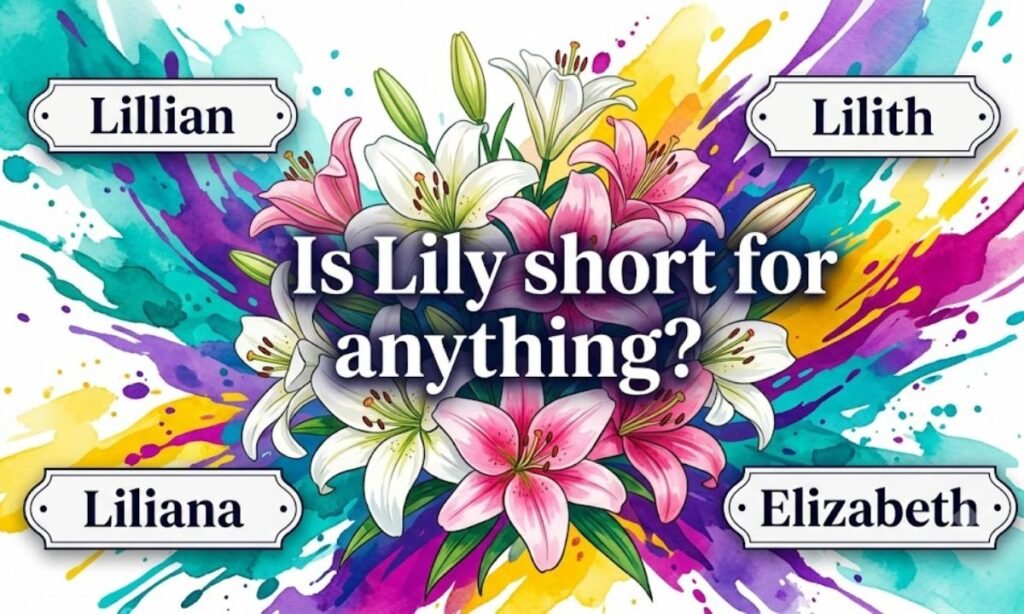
Yes, Lily is most commonly a short form of Lillian, Elizabeth, or Elisabeth. Plenty of grandmothers named Elizabeth get called Lily by family, and it stuck as its own name over time.
It can also stand alone. Many parents today register Lily as the full legal name rather than a nickname, which shows how much the standalone version has grown in popularity.
Other longer names that shorten to Lily include Liliana, Lilith (though that one carries a very different meaning), and Delilah in some families. Each version brings its own flavor while keeping that same soft sound.
So whether you want a full name or a name that could grow into something longer later, Lily works both ways without any awkwardness.
Is Lily a biblical name?
Lily does show up in the Bible, most famously in the phrase “lilies of the field” from the Gospel of Matthew, where they represent trust and being cared for without worry. That single image gave the flower, and later the name, a spiritual weight that lasted centuries.
The Song of Solomon also mentions lilies as a symbol of beauty and love, adding a romantic layer to the biblical connection.
Because of this, Lily has long been considered a name with quiet religious symbolism, even for families who don’t pick names for faith reasons. It sits alongside names like Grace or Faith in that sense.
This biblical tie is part of why the name feels timeless rather than trendy. It was never just a flower name, it was a name with meaning baked into it from ancient texts.
ALSO READ THIS:https://thetophexas.com/traditional-and-melodic-welsh-baby-names/
Why is the lily a royal flower in Britain?
The lily has been tied to British royalty for centuries, often appearing in royal gardens, ceremonies, and even coronation flowers. The white lily especially has stood for majesty and purity within royal tradition.
Queen Victoria was known to favor lilies in floral arrangements, and that royal approval helped cement the flower’s status across English gardens and homes.
Royal weddings have also featured lilies heavily. Lily of the valley showed up in Kate Middleton’s wedding bouquet, tying the flower, and by extension the name, directly to modern royal history.
This royal association gives the name Lily a bit of quiet elegance that other floral names don’t always carry. It’s soft, but it’s also dignified.
And then there’s the fleur-de-lis
The fleur-de-lis is a stylized lily symbol, and while it’s usually linked to French royalty rather than British, it’s worth mentioning because people often confuse the two. The design has represented monarchy, purity, and light across European heraldry for over a thousand years.
It appears on flags, coats of arms, and even scouting badges today, proof of how far this single flower symbol traveled.
Some historians argue the fleur-de-lis was actually based on the iris flower rather than a true lily, but the naming confusion has lasted so long that most people associate it with lilies anyway.
Either way, this symbol adds another layer to why the name Lily feels connected to nobility and grace across European history, not just in Britain.
How popular is Lily in the UK?
Lily has ranked consistently in the UK’s top baby name charts for years, often sitting comfortably in the top 50 for girls. It saw a strong rise in the early 2000s and has held steady ever since.
Part of that popularity comes from its short, clean sound. Parents looking for a name that’s easy to spell and pronounce keep coming back to it.
It also pairs well culturally with the UK’s love of flower names in general, alongside Rose, Poppy, Daisy, and Violet, all of which have seen similar staying power.
If you’re picking a name that won’t feel dated in ten years, Lily’s steady popularity history is a pretty good sign it has real staying power.
Famous people called Lily
Plenty of well known women have carried this name, which adds real world proof of how versatile it is. Here are some notable Lilys and Lilians worth knowing:
• Lily Allen, British singer and songwriter
• Lily Collins, actress known for Emily in Paris
• Lily James, actress from Cinderella and Downton Abbey
• Lily Tomlin, veteran American comedian and actress
• Lily Cole, model and actress
• Lily Aldridge, Victoria’s Secret model
• Lily Rabe, American Horror Story actress
• Lillian Gish, silent film era Hollywood legend
• Lily Pons, famous opera soprano
• Lily Savage, iconic British drag persona created by Paul O’Grady
• Lily Munster, beloved character from The Munsters
• Lily Evans, Harry Potter’s mother in the wizarding world
• Lily Bloom, lead character from the novel It Ends With Us
• Lily van der Woodsen, Gossip Girl character
That’s a wide spread across music, film, literature, and even classic television, which tells you this name never really goes out of style.
What are the nicknames for Lily?
Even though Lily is already short, people still find cute ways to shorten or soften it further. Common nicknames include Lils, Lilo, Lilibit, Lilypad, Lil, and Lulu.
Some families lean into the flower theme even more with pet names like Blossom or Bud, especially for babies.
If Lily is used as a nickname itself for something longer like Lillian or Delilah, then the reverse happens too, family might switch between the long and short form depending on the mood or the occasion.
These nicknames also make the name feel more personal at home, even if the birth certificate says something more formal.
How do you pronounce Lily?

Lily is pronounced LIL-ee, with the stress on the first syllable. It’s a phonetic name, meaning it’s spelled pretty much exactly how it sounds, which is a big reason parents like it.
There’s no tricky silent letter or confusing vowel combo here. Teachers, coworkers, and new friends will get it right on the first try almost every time.
This ease of pronunciation also makes it a smooth choice for multicultural families, since the sound translates cleanly across many languages without much distortion.
Compare that to names with silent letters or unusual spellings, and you can see why Lily remains such a low stress, high reward choice.
What are the different spellings of Lily?
While Lily is the standard English spelling, you’ll also come across Lilly, Lillie, Lilie, and occasionally Lili. Each version carries the exact same meaning and pronunciation, just a slightly different visual style.
Lilly with the double L tends to feel a touch softer or more old fashioned to some parents, while Lili feels more modern or European.
Lillian and Liliana are the longer formal spellings that Lily can shorten from, and both are gaining popularity again as parents look for names that feel a bit more elaborate on paper.
Whichever spelling you go with, the name keeps its warmth and floral roots, so it really comes down to personal taste rather than meaning.
Does Lily work in other languages?
Yes, and this is one of the name’s biggest strengths as an international name. In French, it’s Lys or Lise. In Italian, it becomes Liliana or Giglio inspired variations. In Spanish, Lirio is the flower word, though Lilia is used as a name.
German speakers often use Lilie, while Scandinavian countries frequently use Lilja, which has its own charm and history in Norse naming traditions.
Even in Slavic languages, Lilija or Liliya shows up as a recognized name, proving just how far this flower traveled across cultures and borders.
This global reach makes Lily a smart pick for multicultural or multilingual families who want a name that travels well without needing translation.
What names go well with Lily?
Whether you need a middle name, a sibling name, or just want to see how Lily pairs with other names, here’s a solid list to consider:
• Lily Grace
• Lily Rose
• Lily Mae
• Lily Jane
• Lily Anne
• Lily Claire
• Lily Beth
• Lily Kate
• Lily Faith
• Lily Hope
• Lily Sophia
• Lily Belle
• Lily Marie
• Lily Elizabeth
• Lily Victoria
• Lily Willow
For siblings, Lily pairs naturally with other nature inspired names like Violet, Daisy, Poppy, Ivy, and Hazel, keeping a cohesive botanical theme across the family.
How to make the final decision on the name Lily
If you’re still on the fence, try saying the full name out loud with your last name a few times. Notice how it flows, and picture calling it across a playground or reading it on a school report.
Think about the nicknames too. If you love the sound of Lils or Lilo, that’s a good sign the name will grow with your child rather than feeling stuck at one stage.
It also helps to check how common it is in your specific area or school district if that matters to you, since national popularity charts don’t always reflect your local community.
Lastly, trust the emotional pull. If Lily feels right every time you say it, that reaction usually means more than any ranking or chart ever will.
So is Lily a good name?
Lily has real staying power, backed by centuries of royal symbolism, biblical meaning, and steady popularity across generations. It’s easy to say, easy to spell, and travels well across languages and cultures, which is rare for any name.
From famous actresses to fictional characters to royal wedding bouquets, this name has proven it belongs everywhere. If you’re drawn to something soft, meaningful, and timeless, Lily checks every box without trying too hard. What do you think, does Lily feel like the right fit for you? 🌷