
You’ve probably heard a Welsh name before and thought, wow, that just sounds like a song. Maybe it was a character in a book, or a name on a family tree that made you pause and ask “how do you even say that?” Welsh names carry a rhythm most other languages just don’t have, and once you fall for that sound, it’s hard to settle for anything plain again.
This guide hands you over 50 traditional Welsh names and melodic baby names pulled straight from nature, myth, and old family lines, each one broken down so you actually know what it means and how to say it. By the end, you’ll have a shortlist you actually love, not just a list you skimmed.
A Quick Look at Welsh Naming Traditions
Wales has one of the oldest living Celtic languages in Europe, and its names grew out of poetry, mountains, rivers, and old stories passed around a fire. A lot of these names come straight from the land itself. Words for birds, flowers, waves, and hills got turned into names people gave their kids, which is part of why they still feel so alive.
Old Welsh naming also leaned hard on family. Kids were often named after a parent or grandparent with a small twist, keeping the sound of the family alive across generations. You’ll notice a lot of names below share roots or sounds for exactly this reason. That’s not repetition, that’s tradition.
Long before surnames became common, Welsh people used a system called patronymics, where a child’s name was built around their father’s first name. A boy named Rhys might be called “Rhys ap Gruffudd,” meaning “Rhys, son of Gruffudd,” while a girl might carry “ferch” instead of “ap” to mark “daughter of.” That system faded out over time, but the habit of leaning on strong, meaningful first names stuck around, which is part of why Welsh first names still carry so much weight on their own.
Religion and myth both shaped this naming pool too. Saints, old kings, and figures from the Mabinogion, a collection of medieval Welsh stories, all left their mark on the names still used today. Some names on this list, like Rhiannon and Taliesin, come straight out of those old tales, carrying centuries of storytelling behind a single word.
Wales also went through long stretches where English rule pushed hard against the Welsh language, and for a while, many Welsh families quietly dropped traditional names in favor of English ones just to fit in. That shift started reversing over the past century as Welsh pride grew stronger, and today these old names are having a real moment again, both inside Wales and among families around the world who simply love how they sound. That mix of struggle and revival is part of what makes choosing one of these names feel like more than a style choice. It’s a small nod to a language that fought to stay alive.
What Makes a Welsh Name Sound So Musical?
Welsh spelling looks tricky at first glance, but the language is actually very consistent once you learn a few rules. Every letter has a job. There’s no guessing games like you get in English.
Double consonants like “dd,” “ll,” and “ff” aren’t typos, they’re their own sounds. “Dd” sounds like the “th” in “this.” “Ll” is a soft breathy sound made by pressing your tongue to the roof of your mouth and blowing air past it, kind of like a whispered “th-l.” Vowels are also cleaner in Welsh. “W” often acts like “oo,” and “Y” can sound like “uh” or “ee” depending on where it sits in the word.
Once those rules click, the names stop looking like a puzzle and start sounding like poetry, which is exactly why they roll off the tongue the way they do.
The letter “F” also works differently in Welsh. A single “F” sounds like an English “V,” while a double “FF” sounds like the English “F” you already know. So “Ffion” starts with a firm “F” sound, while a single “F” name would carry a softer “V” tone instead.
Stress in Welsh words almost always lands on the second to last syllable, giving the language a steady, rolling beat that never feels rushed or choppy. That built in rhythm is part of why Welsh names read like tiny songs even before you know what they mean, and it’s worth practicing a name out loud a few times before you settle on it.
ALSO READ THIS:https://thetophexas.com/timeless-mythological-names/
Melodic Welsh Baby Names for Girls
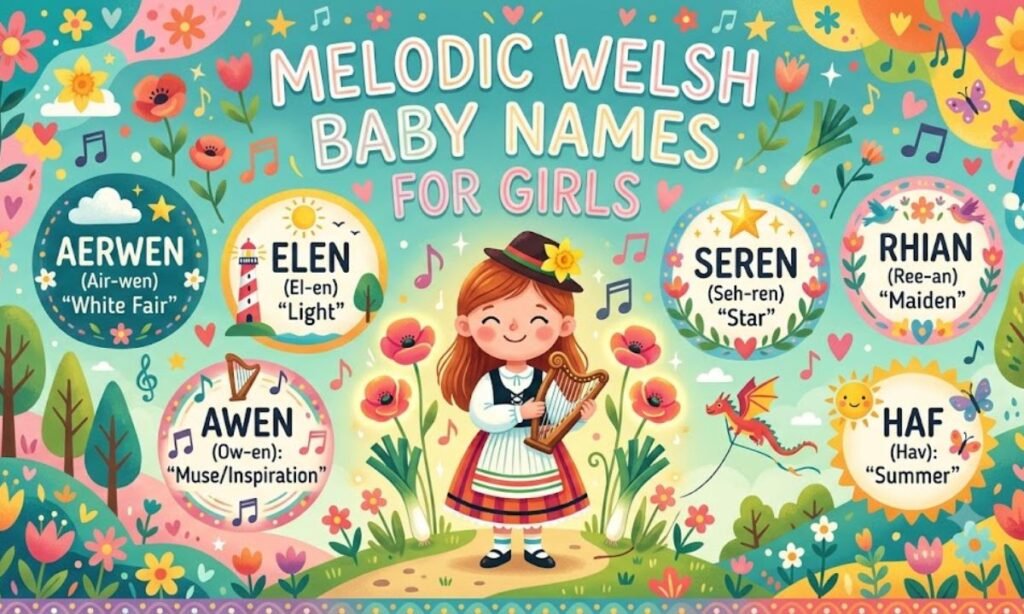
These names lean soft, nature rooted, and full of old world charm. Each one below carries real meaning, not just a pretty sound.
- Ffion – means “foxglove,” the tall purple wildflower that grows across Welsh hillsides.
- Eira – simply means “snow,” a name often given to babies born in the colder months.
- Seren – means “star,” short, bright, and easy to say anywhere in the world.
- Carys – comes from the Welsh word for “love,” warm and gentle sounding.
- Gwen – means “white” or “fair,” one of the oldest and most classic Welsh names still used today.
- Rhiannon – tied to a goddess figure in Welsh mythology connected to birds and horses.
- Angharad – means “much loved,” a name that’s been passed down through Welsh royal lines.
- Bronwen – means “fair breast” in old Welsh, historically linked to beauty and gentleness.
- Enid – means “soul” or “life,” a quiet but powerful choice.
- Nia – means “brightness,” short and easy for any household to use daily.
- Gwendolyn – a longer form of Gwen, meaning “white ring” or “blessed ring.”
- Blodwen – means “white flower,” a full nature-rooted name with real depth.
- Delyth – means “pretty” or “neat,” a soft and rarely used gem.
- Mair – the Welsh version of “Mary,” steady and timeless.
- Olwen – means “white footprint,” tied to an old Welsh legend about a maiden whose steps left flowers behind.
- Rhosyn – means “rose,” a straightforward nature name with a beautiful sound.
- Tegan – means “little darling,” warm and affectionate by nature.
- Wynne – means “fair” or “blessed,” short and clean sounding.
- Arianwen – means “silver” and “white” combined, a name that shines the moment you say it.
A quick personal tip here: shorter names like Nia or Gwen pair beautifully with a longer, more formal middle name, giving you the best of both worlds on a birth certificate and in daily life. If you love the sound of Welsh but worry about spelling struggles at school, names like Seren and Mair are about as simple as it gets while still keeping that authentic Welsh root.
Melodic Welsh Baby Names for Boys
These names carry weight and strength while still keeping that soft musical Welsh flow.
- Rhys – means “ardor” or “enthusiasm,” one of the most recognized Welsh names worldwide.
- Dafydd – the original Welsh form of “David,” strong and rooted in Welsh royal history.
- Gareth – means “gentle,” tied to old tales of knighthood and honor.
- Llewelyn – means “lion-like,” carried by two Welsh princes in history.
- Owain – means “young warrior,” sharp and full of old world grit.
- Emrys – the Welsh form of “Ambrose,” linked to the legend of Merlin himself.
- Ieuan – the Welsh version of “John,” soft yet strong sounding.
- Cadfael – means “battle prince,” a bold and rare pick most people haven’t heard before.
- Gruffudd – means “strong lord,” a name that carried real weight in medieval Wales.
- Idris – means “fiery lord,” tied to a mountain in Wales and now a widely loved name.
- Aled – named after a river in North Wales, short and easy to carry.
- Bryn – simply means “hill,” clean, short, and grounded in the landscape.
- Dylan – means “son of the sea,” one of the most popular Welsh exports globally.
- Gwilym – the Welsh form of “William,” familiar yet distinct.
- Huw – the Welsh form of “Hugh,” short and full of old charm.
- Iestyn – the Welsh version of “Justin,” carrying a softer edge.
- Maddock – means “fortunate” or “good,” a strong pick with a happy meaning.
- Trefor – means “large settlement” or “homestead,” rooted deep in the land.
- Wyn – means “fair” or “blessed,” often used alone or as part of longer names.
Notice how many of these names end in a soft “n” or “s” sound. That’s not an accident, it’s a common pattern in Welsh that gives boys’ names a strong finish without sounding harsh. If you want a name that ages well from nursery to boardroom, Rhys, Dylan, and Owain all sit comfortably in that sweet spot between distinct and easy to say.
Rare and Unique Welsh Baby Names
If you want something almost nobody else will have, these names are where the real hidden gems live.
- Anwen – means “very beautiful,” soft and rarely heard outside Wales.
- Berwyn – means “fair hill” or “white summit,” strong and outdoorsy.
- Caradog – means “beloved” or “amiable,” an old name tied to a legendary Welsh king.
- Efa – the Welsh form of “Eve,” short, clean, and quietly powerful.
- Gethin – means “dusky” or “dark-skinned,” a bold and grounded choice.
- Heledd – tied to an old Welsh poem about resilience and grief, deeply poetic.
- Ifor – means “lord” or “archer,” strong sounding and rarely used today.
- Lowri – the Welsh form of “Laura,” light and cheerful.
- Meredith – originally a Welsh boy’s name meaning “great chief,” now used for both genders.
- Nerys – means “lord,” a strong feminine pick that stands apart from the crowd.
- Osian – tied to a legendary poet and warrior in old Celtic myth.
- Pryderi – a name from Welsh mythology meaning “care” or “loss,” tied to a compelling old legend.
- Rhodri – means “ruler,” carried by an early king of Wales.
- Taliesin – means “shining brow,” tied to one of the most famous poets in Welsh history.
- Ynyr – means “honor,” short, sharp, and almost never heard outside Wales.
These rare picks are perfect if you want a name that starts a real conversation, since most people will ask about the meaning the first time they hear it. Just keep in mind that rarer names sometimes need a quick pronunciation guide on hand for grandparents, teachers, and anyone meeting your child for the first time.
Why Do Welsh Baby Names Sound So Musical?
There’s a real reason these names feel like they’re halfway to being sung already. Welsh is built on strong vowel patterns and soft consonant blends that naturally create rhythm, almost like the language was designed with music in mind.
Old Welsh poetry followed strict sound patterns called cynghanedd, a style built around repeating consonants and rhyme within a single line. Names picked up that same rhythm over hundreds of years, which is why so many Welsh names still feel like tiny poems on their own.
Nature also plays a huge role. So many Welsh names come from rivers, hills, flowers, and weather, and those natural words already carry a soft, flowing sound on their own. Put simple grammar, strong vowels, and nature-rooted words together, and you get names that sound gentle even when their meaning is bold.
Welsh also uses something called mutation, where the first letter of a word can softly shift depending on the words around it. This might sound complicated on paper, but in practice it just smooths out the flow between words, almost like the language naturally avoids harsh, choppy transitions.
Compare that to a lot of freshly invented names, which often get built for looks on a page rather than sound in the mouth. Welsh names had thousands of years of everyday speech to get polished into something that just feels right when spoken out loud, and you can hear that history every time one is said with care.
How to Test a Welsh Name Before You Commit
Picking a name is a big decision, so it helps to actually test it out before it goes on the birth certificate.
- Say the full name out loud with your last name, more than once, in a normal speaking voice.
- Shout it across a room like you’re calling your kid in for dinner. If it feels awkward shouted, that matters.
- Write it down and check how it looks paired with common middle names.
- Ask a few people to try pronouncing it cold, without any hints, so you know how strangers, teachers, or coaches might say it.
- Picture the name on a resume, a wedding invite, and a preschool cubby. Does it still feel right at every stage of life?
- Try texting the name to a close friend or family member and ask them to send back their honest first reaction, since a quick gut response often reveals more than a long thought out answer.
- Check how the name sounds next to any siblings’ names you already have, keeping an ear out for names that rhyme too closely or clash in rhythm.
None of these steps take more than a few minutes, but together they can save you from a name that looks great on paper and feels off in real life.
Tips for Making a Welsh Name Feel Personal
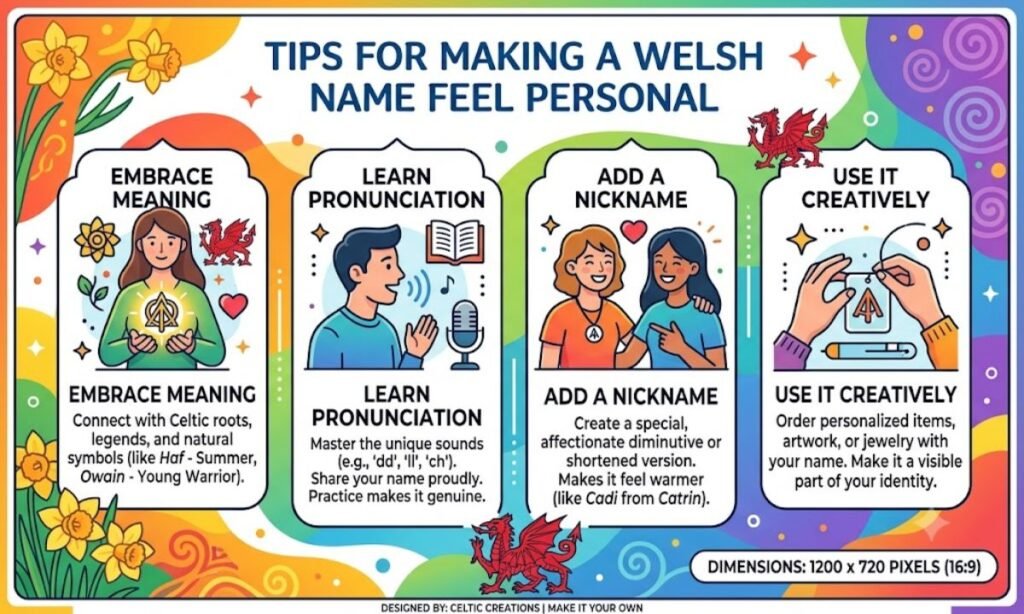
A name means more when it’s tied to something real in your own life, not just picked off a list.
- Look for a name that echoes a family member’s name in sound or meaning, like choosing Gwen if your grandmother was named Gwendolyn.
- Pick a name tied to a place you love, especially if you’ve got any real connection to Wales or the wider Celtic world.
- Choose a meaning that matches something true about your pregnancy or your hopes for your child, like Seren for a baby born under a clear night sky.
- Blend a Welsh first name with a simpler middle name so the full name stays easy to say and write.
- Ask family members what they think out loud, since hearing a name spoken by someone you love often tells you more than reading it silently ever will.
Ways to Build Identity Around a Chosen Name
Once you’ve landed on a name, there are small ways to make it feel woven into your child’s life from day one.
- Share the meaning of the name in a baby book or letter so your child grows up understanding the story behind it.
- Choose a nursery detail, like a star for Seren or a flower for Ffion, that quietly ties back to the meaning.
- Learn the correct Welsh pronunciation together as a family so it’s said with pride, not hesitation.
- Look into any personal or ancestral tie to Wales and share that story as your child grows older.
- Celebrate the name’s roots on birthdays with a small tradition, even something as simple as reading about its meaning each year.
- Keep a small note or card with the name’s meaning and origin tucked into a keepsake box, so your child has something real to look back on someday.
- If the name ties to a real place in Wales, consider visiting one day as a family, turning a name into a shared memory instead of just a word.
Common Mistakes to Avoid When Choosing a Welsh Name
A few small slip ups come up again and again when parents fall in love with a Welsh name, so it helps to know what to watch for early.
- Don’t guess the pronunciation from English spelling rules, since Welsh letters often behave nothing like their English counterparts.
- Avoid picking a name purely from a list without saying it out loud with your surname a few times first.
- Watch out for names that get shortened into something you don’t love, since nicknames tend to stick whether you plan for them or not.
- Don’t skip checking initials, especially with longer double barreled Welsh names that can create an awkward abbreviation.
- Avoid choosing a name only for how it looks written down, since a name gets spoken far more often than it gets read.
Tips for Selecting the Perfect Name for Your Family
With over 50 options on this list, narrowing things down can feel like the hardest part, so here are a few ways to make the choice easier.
- Make a shortlist of five names max, then live with that list for at least a week before deciding.
- Say each name alongside your child’s likely nicknames, sports team names, or class introductions to see how it holds up in daily life.
- Think about how the name will read on official documents, from school forms to future job applications.
- Talk through the shortlist with a partner, close friend, or family member whose opinion you trust, but remember the final call is yours.
- Trust the name that keeps coming back to your mind days later, since that gut pull is usually a strong sign you’ve found the right one.
Final Thoughts
Picking a name is one of the first real gifts you give your child, and Welsh names bring history, sound, and meaning together in a way few languages can match. Whether you land on something classic like Rhys or something rare like Taliesin, you’re choosing a name with real roots and real music behind it.
Take your time with the list above, say the names out loud, and notice which ones stay in your head after you close this page. That’s usually the name that was meant for your family all along, so go ahead and share which one you’re leaning toward.