
Ever wonder why some names just sound posh? Maybe you’re naming a baby, a pet, a character in your book, or even a group chat, and you want that old money charm without trying too hard. This list gives you real posh British names with true upper class heritage, straight from royal nurseries and country estates.
You’ll get girl names, boy names, posh nicknames, and even surnames turned first names, each one with a bit of history so you know exactly why it feels so aristocratic. Grab a cup of tea and let’s get into it.
Posh Girl Names in the UK
British girl names with a posh feel tend to share a few things in common. They often come from Latin or Greek roots. They show up again and again in royal family trees. And they carry a soft, old-fashioned sound that never really goes out of style.
Picture a nanny calling a child in from the garden at a country house in the 1920s. The name she’d shout is probably somewhere on this list. That’s the kind of staying power we’re talking about, names that have survived weddings, wars, and a hundred years of changing trends without losing their shine.
What makes these names different from a passing baby name trend is exactly that staying power. A trendy name can feel dated within a decade, but a genuinely posh name tends to skip that whole cycle entirely, since it was never chosen to sound current in the first place.
ALSO READ MORE:Baby Names That Mean Leader or Protector (70 Strong Names for Boys & Girls)
Top 20 Posh Girl Names
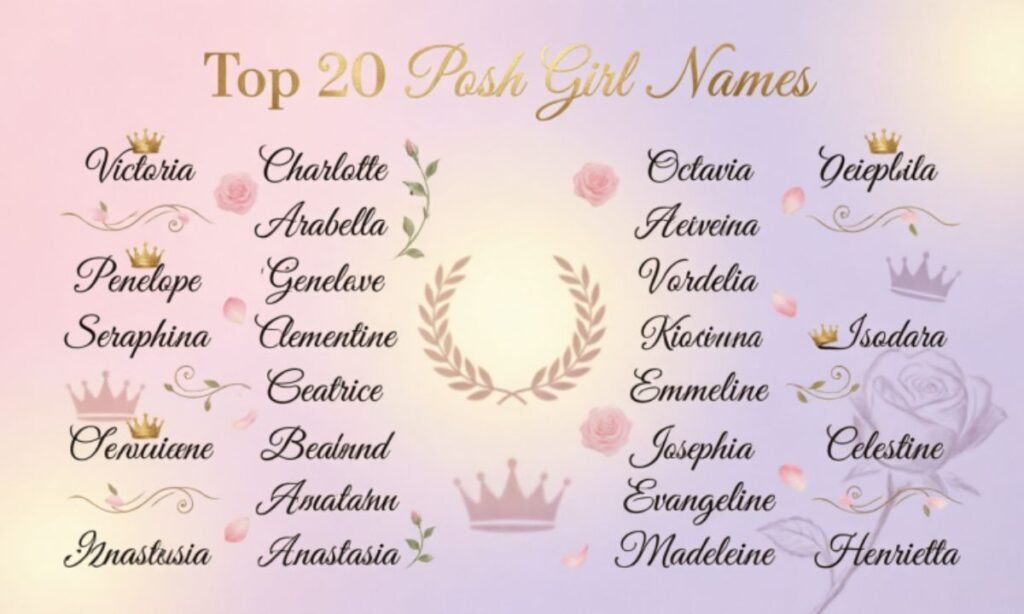
Here’s a strong starting list of posh British girl names that carry serious upper class weight.
- Arabella
- Araminta
- Cressida
- Persephone
- Rosamund
- Clemency
- Tamsin
- Verity
- Cordelia
- Octavia
- Philippa
- Henrietta
- Beatrix
- Isolde
- Marigold
- Genevieve
- Wilhelmina
- Theodora
- Seraphina
- Sybil
Every single one of these feels at home in a country manor. Pick one and it instantly sets a certain tone, without saying a single word about where you grew up or what school you went to. That’s the quiet power of a good posh name, it does the talking for you.
Full List with Origins and Aristocratic Signals
Want more options? Here’s a deeper batch of British aristocratic names for girls, along with where each one comes from and why it reads as posh. This is the kind of list worth bookmarking, since it covers names you’ll rarely see repeated anywhere else, each with its own small piece of history attached.
- Allegra – Italian for lively, adopted by upper class English families for its musical sound
- Anthea – Greek origin meaning flowery, popular among old English gentry
- Belinda – A name with Germanic and Italian roots, common in Regency era novels
- Camilla – Latin origin, tied directly to the British royal family
- Davina – Scottish feminine form of David, favored by landed families
- Elspeth – Scottish form of Elizabeth, carries a castle era feel
- Flavia – Latin for golden, used by classically educated families
- Gwendolen – Welsh origin, meaning white ring, common in nhttps://www.ldoceonline.com/dictionary/alongoble Welsh lines
- Hermione – Greek mythology roots, long used in English upper class circles before it became a pop culture name
- Imogen – Shakespearean origin, a favorite in English literary families
- Jocasta – Greek mythological name, rare and striking
- Lavinia – Roman origin, tied to classical education and old libraries
- Miranda – Latin for admirable, another Shakespearean pick
- Ottoline – French origin, famously carried by a British aristocrat and social hostess
- Petronella – Latin origin, an old English form still used in country families
- Rowena – Old English, meaning fame and joy, tied to medieval legend
- Saskia – Dutch origin, adopted by English families with art world ties
- Tallulah – Native American origin, picked up by British families for its bounce
- Ursula – Latin for little bear, a name with real staying power
- Vita – Latin for life, made famous by a British aristocrat and writer
This kind of range gives you both the well known picks and the rarer finds. Notice how many of these trace straight back to Latin, Greek, or old Welsh roots. That’s not an accident. Families who wanted to signal an education steeped in the classics leaned hard on names their children would carry for life, almost like a small badge of the schoolroom they came from. A name like Flavia or Lavinia does more than sound pretty, it quietly says the family valued Latin lessons and old libraries.
Popular Nicknames for Posh Female Names
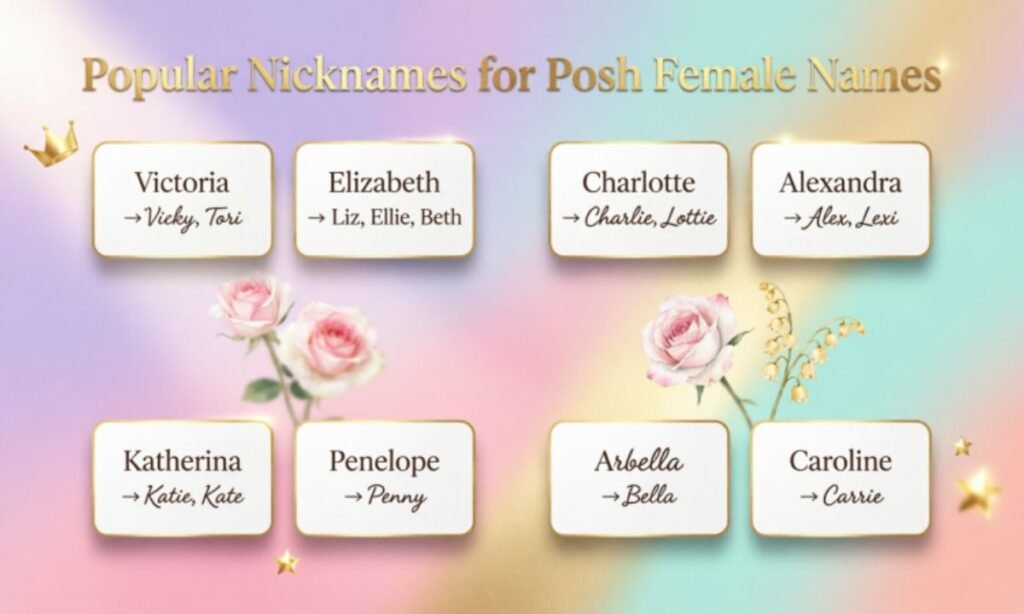
Full names like Araminta or Wilhelmina can feel like a lot for daily use. That’s where posh nicknames come in. They soften the name while keeping the classy edge, and they let a child grow into the longer, grander version once they’re old enough to appreciate it.
- Bella (from Arabella)
- Minty (from Araminta)
- Cressy (from Cressida)
- Percy (from Persephone)
- Ros (from Rosamund)
- Clemmie (from Clemency)
- Tam (from Tamsin)
- Cordy (from Cordelia)
- Tavy (from Octavia)
- Pips (from Philippa)
- Hen (from Henrietta)
- Trixie (from Beatrix)
- Izzy (from Isolde)
- Ginny (from Genevieve)
- Willa (from Wilhelmina)
- Thea (from Theodora)
- Sera (from Seraphina)
- Sib (from Sybil)
- Millie (from Camilla)
- Immy (from Imogen)
These nicknames show up all the time at English boarding schools and family gatherings. They feel warm without losing the polish. You’ll hear a mother call out “Clemmie, tea’s ready!” across a garden and it just fits, in a way that shouting the full formal version never quite would. A good nickname is really a second gift you give a child, a softer name for softer moments.
Posh Boy Names in Britain
Boy names with an upper class British feel usually lean into old aristocratic titles, classical roots, or names passed down through generations of landed families. A lot of these names carry a bit of mischief too, they were often the names of second sons and younger brothers who weren’t expected to inherit the estate, so their parents had more freedom to pick something bold or unusual.
- Tarquin
- Rupert
- Sebastian
- Barnaby
- Hugo
- Casper
- Cosmo
- Rafferty
- Aubrey
- Peregrine
- Bertie
- Fergus
- Lysander
- Otis
- Monty
- Digby
- Ptolemy
- Inigo
- Piers
- Crispin
Any one of these would fit right into a country estate or an old university hall. Say a few out loud and you’ll notice they all carry a bit of confidence built in, the kind of name that doesn’t need a nickname to feel complete.
There’s also a playful streak running through this list. Names like Cosmo and Bertie sound almost like they belong to a favorite uncle who always has a good story ready, which is exactly the kind of warmth a strong posh name can carry alongside its formal side.
Full List with Origins and Historical Context

Here’s a deeper set of posh British boy names, each with a bit of background on where it came from. Between the classical roots and the old royal ties, you’ll notice a clear thread running through nearly every single one of them.
- Alaric – Germanic origin meaning ruler of all, tied to old European nobility
- Ambrose – Greek origin meaning immortal, used by English clergy families for centuries
- Benedict – Latin for blessed, a steady favorite in Catholic aristocratic families
- Caspian – Persian origin, made famous in English literature
- Dashiell – French origin, picked up by literary British families
- Edmund – Old English royal name, tied to actual English kings
- Frederick – Germanic origin meaning peaceful ruler, common in royal lines
- Gideon – Hebrew origin, adopted by English gentry for its strong sound
- Godfrey – Old German origin meaning peace of God, medieval knight energy
- Ignatius – Latin origin, favored by old Catholic families
- Jasper – Persian origin meaning treasurer, a country house classic
- Leopold – Germanic royal name, tied to European royal houses
- Maximilian – Latin origin meaning greatest, a name with real weight
- Nathaniel – Hebrew origin meaning gift of God, common in old English families
- Reginald – Germanic origin meaning powerful ruler, a proper old money pick
- Silas – Latin origin, quietly posh and understated
- Thaddeus – Aramaic origin, rare and distinguished
- Valentine – Latin origin meaning strong, used across old European nobility
- Wilfred – Old English meaning desiring peace, tied to English saints
- Zachariah – Hebrew origin meaning remembered by God, formal and grand
Each name here carries its own bit of family history behind it. What’s interesting is how many started out as religious or classical names before English gentry families adopted them purely for the sound and the weight they carried in a room. A name like Leopold or Maximilian doesn’t just sound grand, it was often chosen because it echoed the name of a European royal house the family admired or was distantly connected to.
Structural Patterns in Posh Male Names
Posh British boy names tend to follow a few clear patterns once you start looking closely.
- Classical roots: Many pull straight from Latin or Greek, giving names like Augustus, Horatio, Linus, Magnus, Julius, Cyrus, Titus, Atticus, Marcus, and Felix their weight and formality.
- Double barrelled combos: Families often stack a first name with a surname middle name, such as Peregrine Alexander Fitzwilliam, to signal lineage on both sides.
- Old saint and king names: Names tied to actual English monarchs or saints, like Edmund or Wilfred, carry built in history.
- Short, punchy nicknames as full names: Bertie, Monty, and Otis work as complete names on their own, not just shortened versions.
- Surname first names: Plenty of posh boy names started life as family surnames before becoming given names, which brings us to the next section.
- Nature and place names: Some posh names borrow from rivers, hills, or old estate grounds, tying a child’s name directly to a real patch of land the family once called home.
Mixing these patterns is exactly how new posh names keep getting created generation after generation. A family might take a classical root name, stack it with a grandmother’s maiden name as a middle name, and shorten the whole thing into a two syllable nickname for daily use. That single child ends up carrying three generations of naming history in one short introduction, which is really the whole point of posh naming in the first place.
Posh Surnames Used as First Names
One of the clearest signs of old money naming style is using a family surname as a first name. It’s a quiet way of keeping a family line alive in every generation.
- Fitzgerald
- Beauchamp
- Cavendish
- Percival
- Wentworth
- Ashworth
- Blackwood
- Carrington
- Dashwood
- Fairfax
- Hargreaves
- Kensington
- Montague
- Pemberton
- Sinclair
- Sterling
- Thackeray
- Vane
- Winchester
- Yorke
Any of these work for a boy or a girl, and they instantly bring a family estate feel to the table. Some of them, like Cavendish or Montague, are practically shorthand for old English wealth on their own, no last name needed to fill in the picture.
Why Do Upper-Class Families Reuse Posh British Surnames?
This tradition goes back centuries. Landed families used surnames as first names to protect inheritance ties and keep a mother’s maiden name alive within the family tree. A surname like Cavendish or Fairfax carried land, title, and history behind it, so giving it to a child kept that connection visible.
It also worked as a quiet flex. Anyone who recognized the surname knew exactly which family the child belonged to, without needing an introduction. Walk into a room and say “this is Fairfax” and anyone who knew the family history would immediately place you somewhere on the map, long before a full biography was needed.
There’s a practical side to it too. Large estates were often passed down through complicated inheritance rules, and keeping a maiden name alive as a first name was one way to protect a claim to land or title if the male line ever ran out. A daughter named Kensington or Sinclair kept that family thread visible on paper for lawyers and relatives alike, even generations later.
That same habit continues today, which is why you still see surnames turning into trendy first names across Britain and beyond. Parents outside the aristocracy have picked up the trend simply because it sounds distinguished, even without the estate or the title behind it.
It’s worth remembering that none of this is set in stone. Plenty of families outside the traditional aristocracy have borrowed the same habit simply because they liked the sound of a strong surname up front, proving that a naming tradition can travel well beyond its original purpose.
Old Money British Names
These names carry that unmistakable country house, tweed jacket, family portrait on the wall kind of energy. Some are first names, some work as surnames too, and every one of them has been quietly passed down through generations without ever chasing a passing trend.
- Alistair
- Beatrice
- Charlton
- Delphine
- Edwina
- Frobisher
- Gwyneth
- Harcourt
- Ivo
- Jemima
- Lachlan
- Marchmont
- Nigella
- Osborne
- Prudence
- Quentin
- Rosalind
- Standish
- Tobias
- Ysolde
Pick any one of these and you’ve got a name built to last for generations. These are the kind of names you’d find carved into a family Bible or stitched onto an old school trunk, names that never chased a trend because they never needed to.
How to Test a Posh Name Before You Commit
A name can look great on a list and still fall flat once it’s actually used every day. Before you settle on anything, put it through a few real world checks first.
- Say it out loud with your full surname to check the flow
- Shout it across a room the way you would call a child in from the garden
- Write it down and see how it looks on a form or invitation
- Ask a couple of honest friends what they think, without leading them
- Picture the nickname it might naturally shrink into
- Try it paired with a sibling’s name or a partner’s name to see if the set feels balanced
A name that survives all six checks is one worth keeping. If it trips you up on even one, it’s worth sitting with a little longer before you commit.
Tips for Making the Name Memorable
A posh name should stick in someone’s head after just one hearing, not because it’s loud or flashy, but because it has a natural rhythm to it.
- Keep the rhythm in mind, a name with two or three syllables tends to land better than something too long
- Pair a softer first name with a strong surname, or the other way round
- Avoid picking something so rare that people constantly ask you to repeat it
- Lean into a bit of personal meaning, a family tie or a place that matters to you
- Test how it sounds shortened into a nickname, since that’s often what sticks
- Notice how it sounds next to common everyday words, since a name gets repeated in sentences more than you’d think
Building an Identity Around Your Chosen Name
A name is really just the start. What builds around it afterward is what makes it feel truly yours, whether that’s a child, a pet, or a group of friends who chat every day.
- If it’s for a group or team, tie the name into a shared story or inside joke
- Add a small symbol, color, or phrase that connects back to the name’s meaning
- Use the name consistently across chats, profiles, and introductions so it sticks
- Let the history behind the name become part of how you talk about it
- Give the name room to grow a personality of its own over time
- Bring the name up naturally in conversation early on, since repetition is what actually makes it feel established
Tips for Selecting the Perfect Posh Name
With well over 125 names on this list, narrowing it down comes down to a few honest questions rather than picking whatever sounds fanciest at first glance.
- Does it match the tone you’re going for, playful, formal, or somewhere in between
- Can you picture using it daily without it feeling like a mouthful
- Does it carry a story or meaning that actually matters to you
- Does it pair well with a middle name or surname you already have
- Would you still love it in ten years
- Does it feel like yours, rather than something borrowed just because it sounds impressive
Answer those honestly and the right name usually becomes pretty obvious. The best posh names aren’t the ones that impress a stranger for five seconds, they’re the ones you’re still happy to say out loud years down the line.
In short, a great posh British name is one that feels both grand and genuinely yours. This list covered girl names, boy names, nicknames, surnames turned first names, and true old money classics, giving you well over 125 options to explore.
Whether you’re naming a child, a pet, a character, or a group of friends, the goal is the same: pick something with real history behind it. Take your time, say a few favorites out loud, and trust the one that feels right the moment you hear it.